Retatrutide vs AOD-9604: What’s the Difference?
The growing interest in peptide research has brought several compounds into discussions surrounding body weight, fat metabolism, and metabolic health. Two names that frequently appear in these conversations are Retatrutide and AOD-9604.
Although both have been investigated in relation to fat and weight management, they are very different compounds. They have different molecular structures, act through different biological pathways, and have very different levels of clinical evidence.
Understanding the difference between Retatrutide vs AOD-9604 is therefore important for anyone researching these compounds.
This article provides an educational comparison of their mechanisms, research history, potential effects, and current evidence.
Research disclaimer: Retatrutide and AOD-9604 should not be assumed to be approved treatments simply because they have been studied scientifically. This article is for educational and research purposes only and is not medical advice.
What Is Retatrutide?
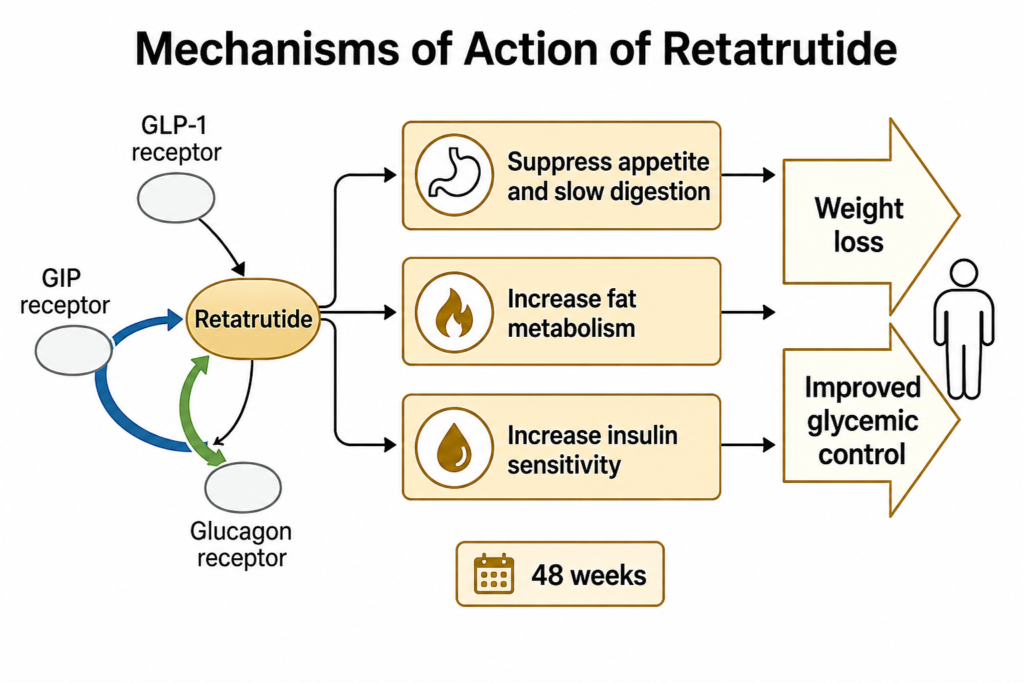
Retatrutide, also known as LY3437943, is an investigational peptide designed to activate three hormone receptors: GIP, GLP-1, and glucagon receptors.
Because it acts on three pathways simultaneously, retatrutide is commonly described as a triple receptor agonist.
GLP-1 and GIP are hormones involved in metabolic regulation, including glucose regulation and appetite-related processes. Glucagon is another hormone involved in energy metabolism.
Researchers have been investigating whether targeting all three pathways can produce greater effects on body weight and metabolic measures than targeting a single pathway.
In a Phase 2 randomized clinical trial involving adults with obesity, retatrutide produced substantial reductions in body weight over 48 weeks. Depending on the dose studied, average weight changes ranged from approximately 8.7% to 24.2%, compared with approximately 2.1% with placebo. Gastrointestinal adverse events were among the most commonly reported side effects, and increases in heart rate were also observed.
These findings generated significant interest in retatrutide research.
However, it is important to distinguish promising clinical-trial results from an approved medical treatment. Retatrutide remains an investigational compound, and research continues to evaluate its long-term efficacy and safety.
What Is AOD-9604?
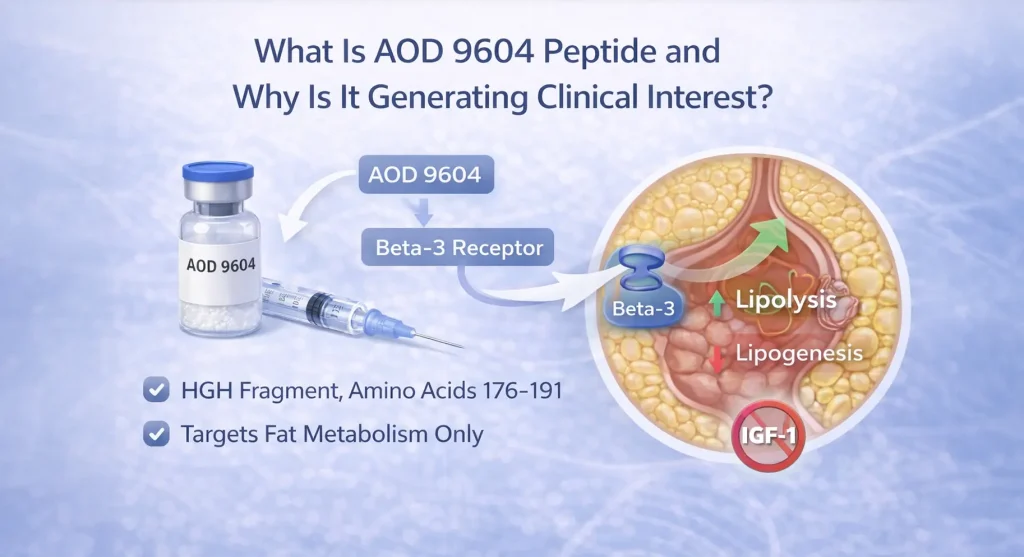
AOD-9604 is structurally very different from retatrutide.
It is a synthetic peptide fragment derived from a portion of human growth hormone. It was originally investigated as a potential anti-obesity compound, with researchers attempting to isolate some of the fat-metabolism-related activity associated with growth hormone without reproducing all of growth hormone’s biological effects.
Preclinical research produced interest in AOD-9604 because studies in animal models suggested effects on fat metabolism.
However, animal results do not necessarily translate into equivalent effects in humans.
AOD-9604 was subsequently investigated in human clinical development programs. According to documentation reviewed by the U.S. FDA, a larger obesity study did not demonstrate the weight loss required to support further commercial development.
This is one of the most important differences when comparing AOD-9604 vs Retatrutide: the evidence base for meaningful weight reduction is considerably stronger for retatrutide.
Retatrutide vs AOD-9604: How Do They Work?
The mechanisms of these two peptides are fundamentally different.
Retatrutide
Retatrutide simultaneously targets:
- GIP receptors
- GLP-1 receptors
- Glucagon receptors
This multi-receptor approach is designed to influence several metabolic pathways at the same time.
GLP-1 and GIP signaling are associated with metabolic regulation and appetite-related processes, while glucagon signaling is involved in energy metabolism.
The combination is one reason researchers have become interested in retatrutide as a next-generation obesity research compound.
AOD-9604
AOD-9604 was developed from a fragment of human growth hormone and has primarily been investigated in connection with lipolysis and fat metabolism.
Rather than functioning as a triple hormone receptor agonist like retatrutide, AOD-9604 represents a completely different research approach.
Its development was based largely on the hypothesis that a specific portion of growth hormone could influence fat metabolism without reproducing the broader effects associated with the complete hormone.
Retatrutide vs AOD-9604 for Weight-Loss Research
One of the biggest differences between the compounds is the amount of human evidence available.
Retatrutide has been studied in randomized clinical trials involving hundreds of participants. In the major Phase 2 obesity study, participants receiving higher doses experienced substantial average reductions in body weight over 48 weeks.
For example, the 12 mg group had an average body-weight reduction of approximately 24.2% at 48 weeks, compared with approximately 2.1% in the placebo group.
These results should not be interpreted as a guarantee that an individual will experience the same result. Clinical-trial outcomes represent averages within specific study populations and conditions.
AOD-9604 has a different research history.
While early research generated interest in its potential effects on fat metabolism, larger human obesity research did not establish the type of clinically meaningful weight reduction needed for continued drug development. FDA documentation specifically notes that the larger obesity trial failed to demonstrate sufficient weight loss compared with placebo.
Therefore, the available evidence does not support treating AOD-9604 and retatrutide as equivalent compounds for weight-loss research.
AOD-9604 vs Retatrutide: Appetite and Metabolism
Another important distinction involves their proposed biological effects.
Retatrutide’s activity at the GLP-1 and GIP receptors has made appetite and metabolic regulation important areas of research. Its additional glucagon receptor activity adds another metabolic pathway to the compound.
AOD-9604 was developed around a different concept: influencing pathways associated with fat metabolism.
This means that comparing the two simply as “fat-burning peptides” can be misleading.
They are not simply two versions of the same type of compound.
Retatrutide is a multi-receptor metabolic agonist, whereas AOD-9604 is a growth-hormone-derived peptide fragment investigated primarily for effects related to fat metabolism.
What Does the Research Say About Safety?
Safety is another area where caution is necessary.
Retatrutide clinical trials have provided human safety data, but researchers are still studying its overall safety profile.
In the Phase 2 obesity trial, gastrointestinal events were among the most common adverse events. These included symptoms associated with the gastrointestinal system and were generally dose-related. Researchers also observed dose-dependent increases in heart rate.
AOD-9604 has also undergone human research.
Published safety information from early studies reported that AOD-9604 was generally well tolerated during the study periods, with no significant changes in IGF-1 observed following the doses examined in those trials.
However, a history of tolerability in clinical research should not be confused with proof that a compound is appropriate for unsupervised use.
Research-stage compounds require careful evaluation of purity, formulation, dosing, interactions, and long-term effects.
Which Has More Clinical Evidence?
When comparing Retatrutide vs AOD-9604, the difference in clinical evidence is significant.
Retatrutide has progressed through multiple human clinical studies and has produced substantial weight-loss signals in randomized trials.
AOD-9604 also reached human clinical research, but its development as an obesity treatment ultimately did not demonstrate sufficient efficacy to continue as a successful obesity drug program.
This distinction is important because marketing claims surrounding research peptides can sometimes make compounds appear much more established than they actually are.
A compound can have an interesting mechanism, positive laboratory findings, or animal data without having demonstrated the same effect in large human clinical trials.
Retatrutide vs AOD-9604: Key Differences
| Feature | Retatrutide | AOD-9604 |
|---|---|---|
| Research type | Investigational metabolic peptide | Investigational peptide fragment |
| Main biological targets | GIP, GLP-1 and glucagon receptors | Growth-hormone-derived fat-metabolism pathway |
| Research focus | Body weight and metabolic regulation | Fat metabolism and obesity research |
| Human research | Extensive clinical investigation | Human clinical research conducted |
| Large obesity studies | Strong weight-loss signals reported | Primary obesity development did not establish sufficient efficacy |
| Mechanism | Triple receptor agonism | GH-derived peptide fragment |
| Current status | Investigational | Not an approved obesity treatment |
Which Is More Interesting for Weight-Loss Research?
From a clinical-research perspective, retatrutide currently has the stronger evidence for substantial weight reduction.
Its triple-receptor mechanism and results from randomized clinical trials have made it one of the more closely watched investigational compounds in obesity research.
AOD-9604 remains scientifically interesting because it represents a different approach to studying fat metabolism.
However, its research history also demonstrates why laboratory or animal findings should not automatically be translated into expectations about human weight loss.
The two compounds should therefore be viewed as separate research subjects rather than interchangeable alternatives.
Why Research Evidence Matters
The peptide market contains a large amount of information, but not all information has the same scientific value.
When evaluating a peptide, it is useful to ask:
Has it been studied in humans?
How large were the studies?
Was there a placebo-controlled comparison?
Were the results statistically and clinically meaningful?
Have the findings been independently replicated?
What are the known risks?
These questions are more useful than simply looking at marketing claims.
For retatrutide, randomized clinical research provides substantial evidence that the compound can produce significant changes in body weight under study conditions.
For AOD-9604, the research history provides a more cautious lesson: promising biological concepts do not always translate into successful human weight-loss treatments.
Final Thoughts
The comparison between Retatrutide vs AOD-9604 highlights two very different approaches to peptide research.
Retatrutide is a triple receptor agonist targeting GIP, GLP-1, and glucagon receptors. Human clinical trials have reported substantial reductions in body weight, making it an important compound in current obesity research.
AOD-9604 is a synthetic fragment derived from human growth hormone that was investigated for its potential influence on fat metabolism. Although early research generated interest, larger human obesity research did not demonstrate sufficient efficacy to support continued development as an obesity drug.
Ultimately, the biggest lesson is that mechanism and marketing should never replace clinical evidence.
Anyone researching peptides should distinguish between laboratory findings, animal studies, early human research, and large randomized clinical trials.
Retatrutide and AOD-9604 are scientifically interesting for very different reasons, but neither should be treated as a substitute for professional medical advice or an established treatment simply because information about them is available online.
Research compounds should be evaluated based on evidence, study quality, safety data, and regulatory status—not hype.
Frequently Asked Questions About Retatrutide vs AOD-9604
1. What is the difference between Retatrutide and AOD-9604?
Retatrutide and AOD-9604 are different investigational peptide compounds. Retatrutide is designed to activate GIP, GLP-1 and glucagon receptors, while AOD-9604 is a synthetic peptide fragment derived from human growth hormone that has been investigated in relation to fat metabolism.
2. Which has more weight-loss research, Retatrutide or AOD-9604?
Retatrutide currently has stronger human clinical evidence for weight reduction. Clinical trials have reported substantial average reductions in body weight, whereas AOD-9604 did not demonstrate sufficient efficacy in a larger obesity study to continue development as an obesity treatment.
3. Is Retatrutide the same as AOD-9604?
No. Retatrutide and AOD-9604 have different structures and mechanisms of action. Retatrutide is a triple-receptor agonist, while AOD-9604 is a growth-hormone-derived peptide fragment investigated primarily for fat-metabolism research.
4. How does Retatrutide work?
Retatrutide is designed to activate three receptors: GIP, GLP-1 and glucagon. Researchers are investigating how this combination may influence appetite, energy metabolism and body weight.
5. What is AOD-9604 used for in research?
AOD-9604 has been investigated primarily in connection with fat metabolism and obesity research. It was developed from a fragment of human growth hormone and studied to determine whether that fragment could influence fat-related pathways.
6. Is Retatrutide approved in the UK?
No. Retatrutide has not been authorised for use in the UK. The UK Medicines and Healthcare products Regulatory Agency (MHRA) has also warned about unlicensed retatrutide products being sold outside authorised clinical trials.
7. Is AOD-9604 approved for weight loss?
AOD-9604 should not be described as an approved weight-loss medicine. Although it has been investigated in human studies, its development as an obesity treatment did not demonstrate sufficient efficacy.
8. Why are Retatrutide and AOD-9604 compared?
Both compounds are discussed online in relation to weight and fat-metabolism research. However, they work through different biological pathways and have different research histories, making it important to evaluate them separately.
9. Which is more extensively studied in humans?
Retatrutide has generated substantial human clinical research, including randomised controlled trials investigating obesity and body-weight outcomes. AOD-9604 has also undergone human research, but its development history for obesity has been less successful.
10. Are Retatrutide and AOD-9604 interchangeable?
No. They have different mechanisms, research objectives and evidence bases. Results from research involving one compound should not automatically be applied to the other.
11. What should I consider when researching peptides?
Look at the quality of the available evidence, including whether studies were conducted in humans, the number of participants, study design, duration, reported adverse events, peer-reviewed publications and regulatory status. Research findings should be distinguished from marketing claims.
12. Where can I learn more about Retatrutide and AOD-9604 research?
Scientific publications, clinical-trial records and information from medicines regulators are more reliable sources than promotional claims. Research should always be interpreted in the context of study quality, limitations and current regulatory status.